Dog Breeds · large
Labrador Retriever: why it's hungry even after just eating
The most popular breed in the United States for 31 years running hides a genetic mutation that explains its endless appetite. A complete guide to the Labrador Retriever for owners who want to live with one without ending up with an obese dog.
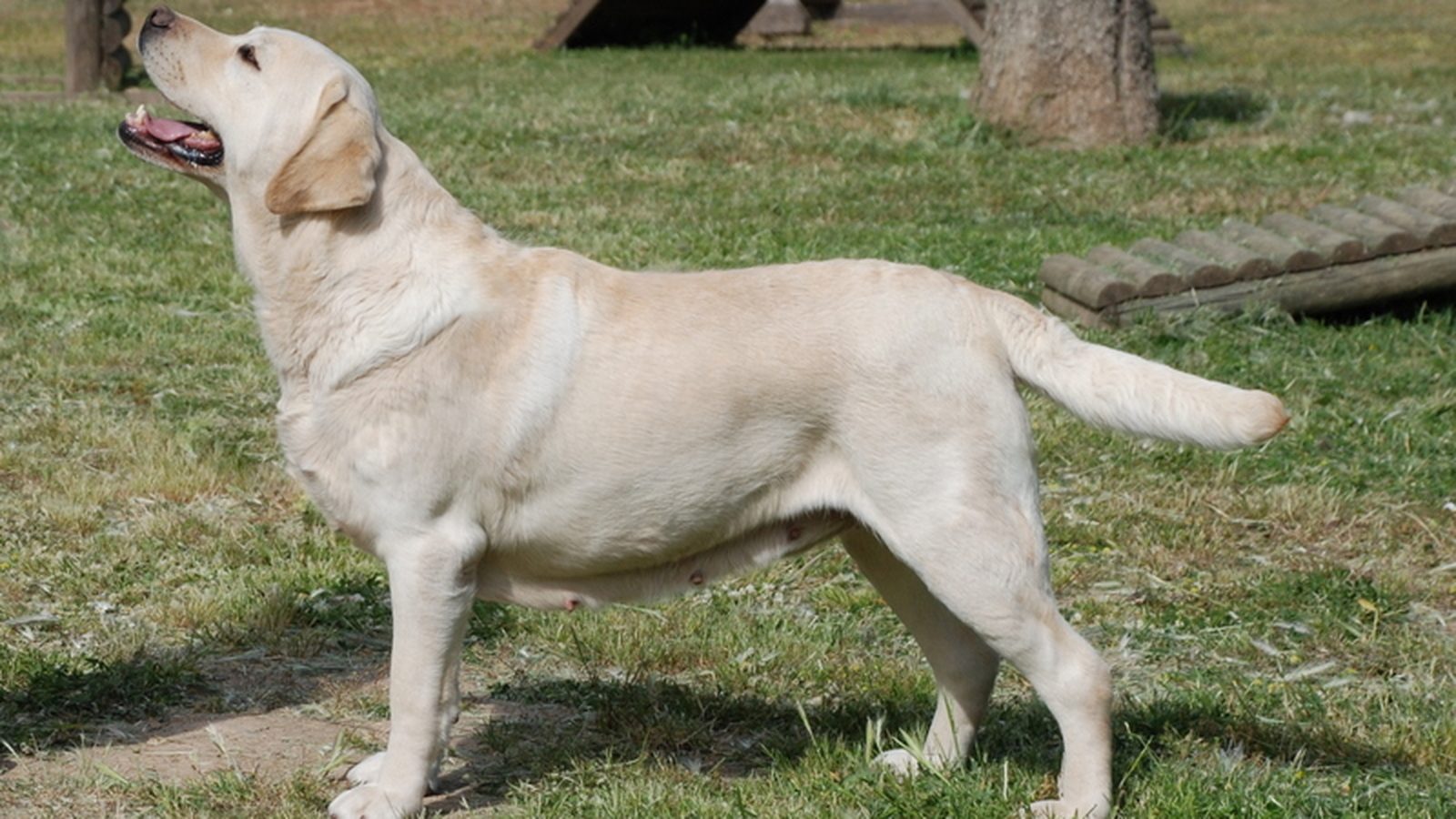
Eleanor Raffan had spent years running a canine obesity clinic at the University of Cambridge when she started to suspect something was off. Anguished owners, strict diets, daily exercise, and yet the dog kept gaining weight. The common factor: almost all of them were Labradors. In 2016 she published in Cell Metabolism the finding that changed the conversation. On chromosome 22 of the most popular breed on the planet, there's frequently a small deletion in the POMC gene. When it shows up, the animal doesn't receive the satiety signal properly. It's hungry, literally, all the time.
That explains scenes any owner will recognize: the trash can knocked over at night, the sandwich stolen off the park bench, the fixed stare at the refrigerator that doesn't look like a whim but an urgent request.
It's worth getting this data straight before anything else, because almost everything about this dog (its health, its lifespan, its behavior) hinges on a single variable.
Why are Labradors always hungry?
About 25% of the British Labradors analyzed by the Cambridge team carry the POMC mutation, a figure that rises to 70% in lines selected for guide dog work. It makes evolutionary sense: for decades, breeders chose the most food-motivated individuals as breeders, because that makes training with rewards far easier. That same motivation, in a dog that no longer works retrieving game from the marsh, becomes a metabolic problem.
The POMC gene codes for a precursor protein involved in appetite and energy expenditure. When the fragment is missing, the organism produces fewer "enough now" signals. Follow-up studies from the Cambridge Veterinary School have documented that these animals eat more when given free access and, on top of that, burn fewer calories at rest.
This shifts the blame that's usually placed by default on the owner of a fat Labrador. Some dogs gain weight on the standard bag portion. What works: weighing food in grams or ounces, not scooping it; using formulas designed for large breeds prone to obesity; and understanding that treats count within the daily total, not on top of it.
How much exercise does a Labrador Retriever actually need?
Popular guides talk about "an hour a day." That's not enough for a healthy adult. The figure veterinary sports specialists use is closer to two hours, split up with varied intensity:
- 60 to 90 minutes of physical activity (brisk walking, light jogging, retrieve play, swimming), preferably with off-leash time.
- 30 minutes of mental work: dummy retrieves, scent searches, puzzle feeders.
- Water access whenever possible. Labradors don't swim on a whim; they're built for it, with partially webbed feet and a thick "otter tail" that acts as a rudder.
Without that expenditure, the combination of genetic appetite and sedentary life almost always ends in overweight. And being overweight in this breed isn't cosmetic: it accelerates osteoarthritis, multiplies the risk of cranial cruciate ligament rupture, and shortens life. A longitudinal study at Purdue University showed that dogs kept at optimal weight live, on average, two years longer than their overfed littermates. Two years, in a twelve-year life, is a lot.
What is the Labrador Retriever's true temperament?
There's a marketing cliché (yellow puppy in a wicker basket) that empties the real dog of content. But the cliché doesn't come from nothing: the Labrador is one of the most stable temperaments produced by selection. Three traits define it, observable from eight weeks of age.
The first is social tolerance. It doesn't usually show reactivity toward strangers, rowdy children, or other dogs. The selection pressure was the opposite of a guard dog's: a retriever couldn't bite the hunter or his companions, and any individual that sank its teeth into the bird was culled. The famous "soft mouth," the ability to carry an egg without breaking it, comes from that.
The second is motivation to work with people. It looks constantly at its handler and enjoys carrying out tasks. Combined with its intense food drive, it becomes the easiest dog to train in practical terms. That's why it dominates assistance programs: organizations like Canine Companions, Guide Dogs for the Blind and Leader Dogs for the Blind graduate hundreds of Labrador and Golden lines every year as guide and service dogs.
The third is sustained but manageable energy. It doesn't have the obsessive intensity of a Border Collie or the independence of a Husky. Its level resembles that of a calm athlete: it needs outings, it needs serious activity, but once back home it lies down and rests.
Is it a good breed for families with children?
Without commercial sugarcoating: yes, it is. Its patience with tugs, awkward hugs, and shouting children is genuine. Early socialization between 8 and 16 weeks reinforces that base, but the genetic substrate is already there.
Three practical warnings, however. An adult Labrador weighs 55 to 80 pounds and can knock down a small child just with tail-wagging enthusiasm: it's mass, not aggression, but living with infants requires constant supervision. The breed loves food, and that includes the child's snack in hand; you have to teach from day one that human food is not to be demanded. And a young dog's energy, uncanalized, shows up on the couch, on furniture, and on any chewable object: until age three, this is a large puppy with adult strength.
What health issues are common in the Labrador?
Beyond obesity, four groups of hereditary pathologies are well-documented in the breed. Before accepting any puppy, parent health certifications are non-negotiable.
| Condition | Type | Test available |
|---|---|---|
| Hip dysplasia | Hereditary joint | OFA or PennHIP radiograph |
| Elbow dysplasia | Hereditary joint | OFA radiograph |
| Progressive retinal atrophy (prcd-PRA) | Hereditary eye degeneration | Genetic test |
| Centronuclear myopathy (CNM) | Hereditary neuromuscular | Genetic test |
| Cranial cruciate ligament rupture | Acquired orthopedic with predisposing base | No predictive test |
Hip dysplasia is the historic pathology and the reason the Orthopedic Foundation for Animals (OFA) and the PennHIP method exist. The Labrador Retriever Club, Inc., the AKC parent club, requires CHIC-certified health testing for member breeders. Elbow dysplasia, less famous, is just as disabling from age six or seven. PRA leads to progressive blindness in young adults and is identified with a simple DNA test. Centronuclear myopathy is the least known of the quartet: it causes generalized muscle weakness in puppies a few months old and, once it appears, has no curative treatment. A genetic test has existed since 2005 and any serious breeder runs it.
On top of this comes a striking predisposition to cranial cruciate ligament rupture, an injury that in sedentary or overweight adult Labradors shows up without any clear accident. Surgery costs between $3,500 and $6,000 at U.S. specialty clinics (TPLO or TTA), and recovery is measured in months. Another reason to keep the animal at optimal weight from a young age and to introduce, from around age five, an orthopedic bed sized for the breed and a joint supplement with actual evidence.
How do you feed a Labrador without inflating it?
Three practical ideas, in order of importance:
1. Weigh the kibble, don't eyeball the cup. A "level" cup contains between 95 and 130 grams depending on brand and density. A 65-pound adult at healthy weight typically needs between 11 and 15 ounces (320-420 g) per day of a premium dry food, split into two meals. The exact figure depends on the food's caloric density and real exercise, not the owner's feel. If your Lab vacuums the bowl in 90 seconds, a slow feeder bowl sized for the breed cuts intake speed up to tenfold and improves satiety.
2. Reserve part of the ration for treats. This is where most owners slip. Training treats, the chunk of cheese for hiding a pill, the leftover crust: it all adds up. A useful practice: at the start of the day, set aside the total ration and earmark 10-15% for treats, subtracting it from the meals.
3. Choose a food designed for the breed. Formulas for "large breeds prone to obesity" or specific to Labrador and Golden Retriever usually have reduced caloric density (350-370 kcal/100 g instead of 400-420), animal protein above 26%, moderate fat (12-14%), elevated fiber, and often L-carnitine and joint support. They serve a real function, not a marketing one.
From age seven onward, metabolism slows and the dog keeps asking just the same. That's the time to drop the grams and switch to a senior formula with reinforced joint support.
Training: the food-motivation superpower
What in other breeds is an occasional virtue is, in this retriever, a superpower. Almost anything can be taught with a treat in hand, and positive reinforcement doesn't just work "well" here, it works exceptionally well. A dog this motivated by food is one you can chain a hundred complex behaviors with, without losing interest.
The opposite is also worth being clear about: with harsh methods, the Labrador doesn't become obedient, it becomes dim. It loses sparkle, lowers its head, stops offering behaviors. Rehabilitating one trained with leash pops takes months.
A note on puppies: overstimulation is real. They can jump, bark, pull, and play-bite with an intensity that scares people. It's uncanalized energy, not aggression. The formula that works: broad socialization between 8 and 16 weeks, short obedience sessions with reward (5-10 minutes, several times a day), and well-managed physical exercise from six months on, avoiding high-impact work before growth plates close.
How do you get a Labrador Retriever in the United States?
Three reasonable routes, in order of reliability:
1. AKC-affiliated breeders. The American Kennel Club maintains a public breeder directory, and the Labrador Retriever Club, Inc. lists CHIC-certified breeders who run the four required tests: OFA hips, OFA or PennHIP elbows, eye exam (CAER), and EIC genetic test. In 2026, a puppy from show lines with pedigree and full health clearances costs between $1,500 and $3,500. Field-trial or working lines with titled parents reach $2,500 to $5,000. Below $1,000, except in justified cases, be suspicious: puppy mills and backyard breeders frequently sell unhealth-tested Labs in that range.
2. Service dog foundation career changes. Organizations like Canine Companions, Guide Dogs for the Blind, and Leader Dogs for the Blind selectively breed lines with stable temperament and verified health. Occasionally they release dogs that don't complete the final training program (too playful, or temperamentally unsuited to guide work): exceptional animals for families. The waiting list is long but the quality is unmatched.
3. Breed rescue and adoption. Because of its size and the number of owners who pick the breed without measuring the exercise required, Labradors fill shelters frequently. National networks like Labrador Retriever Rescue, Inc. and regional clubs handle re-homing. A well-evaluated adult is a great option for someone who doesn't want to deal with the puppy phase.
In any case, microchipping is recommended (and required in some states for licensing or recovery), and county-level licensing usually requires proof of rabies vaccination. Some states also require breeders to register if they reach certain litter volumes. Pet insurance is not legally mandatory but, given the breed's predisposition to cruciate injuries and joint surgery, it pays for itself.
Labrador Retriever data sheet
| Item | Value |
|---|---|
| AKC group | Sporting Group |
| FCI group | 8 (retrievers, flushing dogs and water dogs) |
| FCI section | 1 (retrievers) |
| Standard | AKC Official Standard / FCI 122 |
| Origin | Newfoundland (Canada), developed in the United Kingdom |
| Height at withers | 22.5-24.5 in (males), 21.5-23.5 in (females) |
| Weight | 65-80 lb / 29-36 kg (males), 55-70 lb / 25-32 kg (females) |
| Life expectancy | 10-14 years |
| Coat type | Double, short, dense, water-resistant |
| Colors | Solid black, yellow (light cream to fox red), chocolate |
| Energy level | High |
| Exercise needs | 90-120 min physical + 30 min mental |
| Trainability | Excellent, food-motivated |
| With children | Very good, with supervision |
| With other dogs | Generally good |
| Apartment-suitable | Yes, with sufficient daily exercise |
| Obesity risk | High, with documented genetic base |
Is the Labrador Retriever for you?
If you have an hour and a half to two hours daily to move the animal, if you understand that the scale will matter as much as the leash, and if a big, sociable dog ready to join in whatever you do fits your life, this breed will give you one of the most generous companions out there. If your life is sedentary or you feel guilty saying no to a piece of bread, pick another: that mismanaged tenderness becomes an obese, arthritic dog at age six.
Frequently asked questions
How much does it cost to keep a Labrador per year in the United States? Between $1,800 and $2,800 in recurring spending: premium kibble ($60-90/month for a 30-pound bag), annual vaccinations and parasite prevention ($300-600 depending on heartworm and tick coverage), pet insurance ($400-700/year is typical for the breed), and routine accessories. Unforeseen medical issues (cruciate surgery, advanced dysplasia) can multiply the figure: TPLO surgery alone runs $4,000-6,000 per knee.
Does it shed a lot? Yes, more than the coat appearance suggests. The double coat sheds steadily year-round and very intensely during the spring and fall blowouts. Brushing two to three times a week in normal season, daily during the blow. A vacuum is part of mandatory house equipment for owners of this breed.
Can it live in an apartment? Yes, perfectly well, if it gets the daily exercise it needs. Unlike a Border Collie, the Labrador doesn't redecorate the living room when bored: it just eats and sleeps. The problem in an apartment is the sedentarism risk if owners settle for short walks, not the living arrangement.
Is it ever aggressive? Not by standard. The FCI describes its temperament as "very agile and gentle, with an absence of aggression or unjustified shyness." Real aggression in the breed is rare and almost always points to mishandling, learned fear, or deficient socialization.
How long does a Labrador Retriever live? Between 10 and 14 years on average. Individuals at optimal weight with daily exercise frequently reach 13 or 14. Chronic overweight cuts about two years off the dog's life.
Bibliography
- American Kennel Club. Annual breed registration statistics, 1991-2022.
- American Kennel Club. Official Breed Standard: Labrador Retriever.
- Labrador Retriever Club, Inc. CHIC health testing requirements.
- Fédération Cynologique Internationale. FCI-Standard N°122 / Labrador Retriever.
- Raffan, E. et al. (2016). A Deletion in the Canine POMC Gene Is Associated with Weight and Appetite in Obesity-Prone Labrador Retriever Dogs. Cell Metabolism, 23(5), 893-900.
- Cambridge Veterinary School. Research program on canine obesity and the POMC gene.
- Kealy, R.D. et al. (2002). Effects of diet restriction on life span and age-related changes in dogs. Journal of the American Veterinary Medical Association, 220(9), 1315-1320.
- Orthopedic Foundation for Animals (OFA). Hip and elbow dysplasia screening protocols.
Sources
- American Kennel Club, breed registration statistics 1991-2022
- American Kennel Club, Official Breed Standard: Labrador Retriever
- Fédération Cynologique Internationale, FCI-Standard N°122 / Labrador Retriever
- Raffan, E. et al. (2016). A Deletion in the Canine POMC Gene Is Associated with Weight and Appetite in Obesity-Prone Labrador Retriever Dogs. Cell Metabolism, 23(5), 893-900
- Cambridge Veterinary School, canine obesity research program
- Kealy, R.D. et al. (2002). Effects of diet restriction on life span and age-related changes in dogs. JAVMA, 220(9), 1315-1320